
Willed Body Memorial Service Honors Those Who Donated
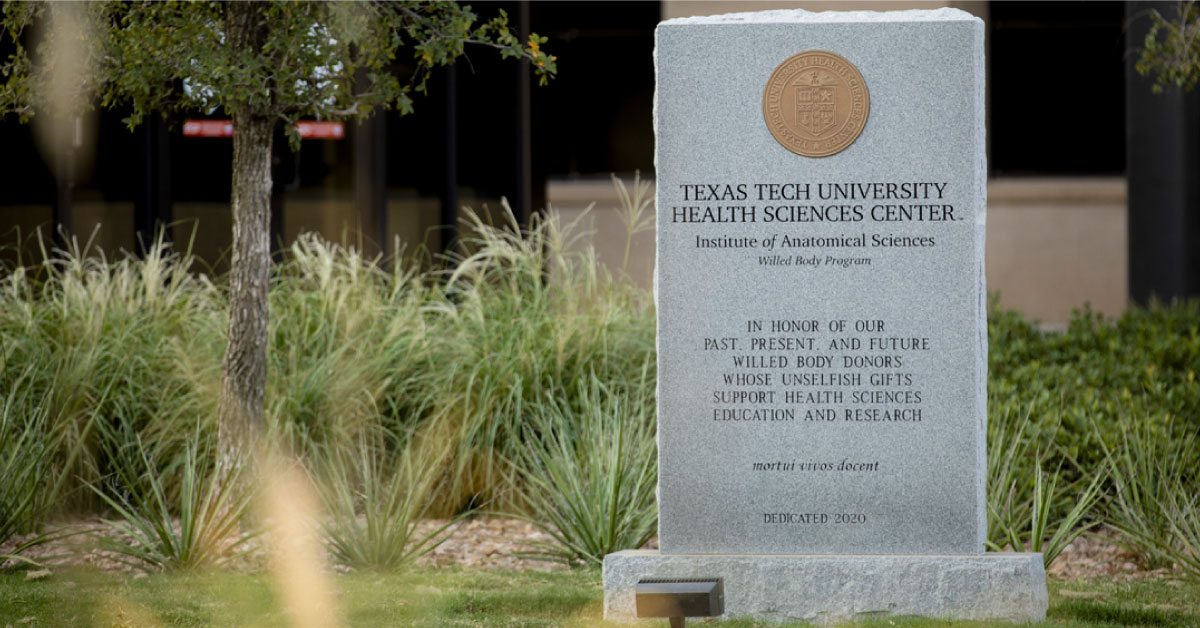
In 2020, Texas Tech University Health Sciences Center (TTUHSC) opened the only anatomical sciences institute in Texas: a 19,000-square foot facility supporting the university’s Anatomical Sciences Program. The foundation of the TTUHSC Institute of Anatomical Sciences (IAS) was built on the university’s Willed Body Program, which has been a crucial part of West Texas healthcare education since 1972.
On Memorial Day each May, a service is conducted to pay respect to the Willed Body Program donors and their families. Kerry Gilbert, PT, Sc.D., assistant dean for anatomy, research and education at TTUHSC and Co-Director for IAS, said that this unique service creates a real and tangible way for families and willed body donors to be honored for their gift.
“It also helps family and friends receive some closure to the grieving process, as many have chosen to receive their loved one’s cremated remains back into their family," Gilbert said.
Willed Body Program Donor Administrator Deanna Wise explained that the Willed Body Memorial service provides an opportunity for students to personally express gratitude directly to donor families and to share the personal and professional impact these generous gifts have had on their education and future careers.
“I have personally witnessed how meaningful this event can be for families and loved ones,” Wise said. “It offers a space for connection with others who have shared the experience of whole-body donation—a decision that can sometimes feel difficult or confusing for those left behind. The ceremony helps bring understanding, comfort and recognition to the donor’s lasting contribution to medicine and the education of future healthcare professionals.”
The service provides a space to memorialize those that have donated their bodies in the last calendar year and to honor them with friends and family. The memorial service is conducted by TTUHSC IAS and Willed Body Program. Many students get to share meaningful moments—not only for education and research but how these donations open the doors to personal growth for future clinicians, who grow a newfound sense of respect and compassion for patients.
By providing a memorial service for donor families to hear from the students who benefited from their loved one’s gift, families can gain a better understanding of the donation process and what their donation really means on a larger scale.
“The Institute of Anatomical Sciences is an amazing facility—but without the gracious gifts of the willed body donors, there would be no activity within the IAS,” said Gilbert. “There would be no learning, no research, and no clinical skill training. Without the willed body donors we could not accomplish our mission.”
TTUHSC’s Willed Body Program is not the only one in Texas (there are 11 willed body programs across the state, all housed within a health related institution and governed by the Anatomical Board of the State of Texas), but TTUHSC’s Willed Body Program holds the responsibility of covering a larger geographic area than most of the other programs, many of which are generally concentrated in more densely populated parts of the state such as the Dallas-Fort Worth, Houston, and San Antonio areas.
When students begin their education at the IAS, each dissection group of four to five students is assigned a donor cadaver. However, students’ access to the donor cadavers is not limited to only one donor. This allows each student to study the structure and anatomy of donors with a wide range of medical conditions and disorders, broadening the scope of their training. The program also provides an opportunity for medical professionals already serving the West Texas region to hone their skills and research new treatment techniques, which better serves patients—all due to the generosity of whole-body donors.
“The gracious gift of our donors allows students to have valuable and real-world experience,” said Willed Body Program Manager Rex Johnson. “Most students understand more about the entire body when they spend time with that donor in class. I believe they are better prepared moving forward in their education once this foundation has been set.”
At the conclusion of the course, each donor body is cremated. The remains are then returned to the families who have elected to receive them. Unclaimed or unreturned remains are commingled in TTUHSC’s ossuary. The lessons provided to future clinicians, however, live on and continue to make a difference.
With the Willed Body Memorial Service, the program aims to honor and give thanks to the individuals who donated and their families. As it continues to provide training, research, and education, the IAS seeks to fulfill the wishes of donors with transparency and respect.
To those who donate and their families, the IAS expressed only tremendous gratitude.
“Thank you to the families,” Gilbert said, “for their loved one’s generosity toward the health sciences. Students from many disciplines learn from these donations and we are very thankful.”
The IAS office is available by phone or email for any questions about the TTUHSC-IAS Willed Body Program. Groups and organizations may also arrange for a presentation about the program.
The Willed Body Memorial Services are open to the public and any who wish to join are welcome.
Related Stories
Stay Safe: Preventing Summertime Dehydration
As the summer heat continues to intensify, so does the risk for dehydration. Prioritizing hydration this summer can protect you and your loved ones from potentially life-threatening complications.
Gov. Abbott Reappoints Varma to Texas Medical Board
Gov. Greg Abbott recently reappointed Surendra Varma, M.D., to the Texas Medical Board (TMB) District Three Review Committee.
Labor of Love: More Women Turn to Nurse-Midwives for Healthcare
In hospitals, birth centers and private homes across the country, nurse-midwives are expanding women’s healthcare options.
Recent Stories
From Backpacks to White Coats
TTUHSC School of Medicine Admissions Office team members delivered critical school supplies worth nearly $6,500 in total on Thursday, Aug. 6, to Bayless Elementary School.
TTUHSC School of Medicine Students Receive First White Coat
The TTUHSC School of Medicine Class of 2030 received their first white coat and pledged their commitment to the medical profession at the White Coat Ceremony today.
TTUHSC Professor Reflects on Decades of Research Benefitting Thousands of Families
After nearly 50 years with the university, Samuel Prien, Ph.D., has been packing up his office in preparation for retirement in August. Although he’s moving on, his impact at TTUHSC will remain.