
‘Tropical Neglected Disease’ Not Forgotten by TTUHSC Researcher
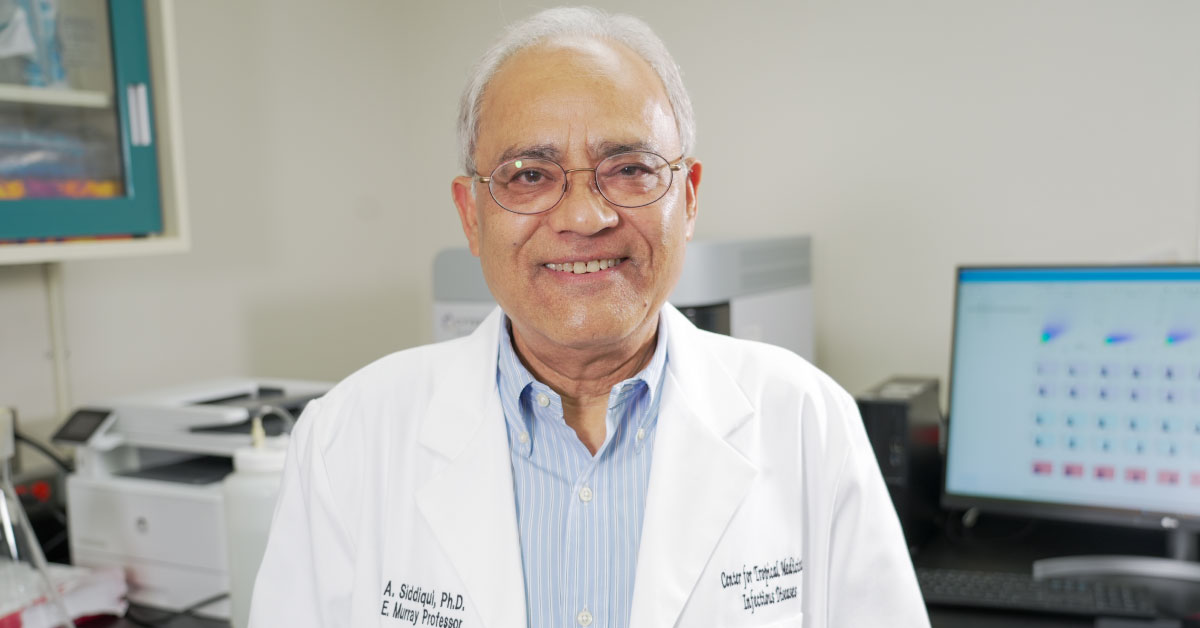
Afzal Siddiqui, Ph.D.
Some call it a “neglected disease.” Schistosomiasis is one of the world's oldest parasitic diseases. There’s evidence of human infection dating back more than 6,000 years. Today, it impacts an estimated 250 million people, with millions more at risk of infection. The disease is most prevalent in impoverished communities in tropical and subtropical regions, with sub-Saharan Africa among the areas most affected.
“You probably have seen pictures of small kids in Africa with bulging bellies; that is because of these parasitic diseases they have,” Afzal Siddiqui, Ph.D., a researcher at Texas Tech University Health Sciences Center (TTUHSC), said.
One of those parasitic diseases is schistosomiasis, which is caused by small worms called blood flukes. The parasite’s microscopic larvae contaminate freshwater sources and then penetrate people’s skin, where they develop into egg-producing worms.
“That’s what the major disease of this parasite is: pathologies produced by the eggs,” Siddiqui said.
Among parasitic diseases, schistosomiasis is second only to malaria in terms of risk. Siddiqui said that over the past 50 years, he’s seen the disease continue to expand, and with only one drug available for treatment, more needs to be done.
Siddiqui not only identified a problem, but also set to work on developing a solution: SchistoShield®, the first vaccine being tested to prevent schistosomiasis. New research demonstrates its effectiveness. Published in NPJ Vaccines, the study “Schistosomiasis vaccine SchistoShield® induces functional immune memory responses in US and African populations,” found that the vaccine induced strong immune responses. Researchers, including Mumtaz Yaseen, Ph.D., an associate professor in the TTUHSC Department of Immunology and Molecular Microbiology, reported that “the SchistoShield® vaccine induced robust cell-mediated effector and memory responses, hallmarks of a potentially efficacious vaccine against schistosome/helminth parasites.”
“For any vaccine to be effective, the vaccine has to have some sort of response,” Siddiqui explained. “Your immune cells have to remember that there is a pathogen which is coming, and we have to fight that. Also, they have to have some sort of memory, long-term memory. That way, the cells can recall it so that they can divide, expand and kill the parasite. That’s what we found that the people we have vaccinated, both in the U.S. and in Africa, they have the memory response, both B-cell and T-cell-based.”
Siddiqui is the director of the TTUHSC Center for Tropical Medicine and Infectious Diseases and chair of the Department of Immunology and Molecular Microbiology at the TTUHSC School of Medicine. He’s been working on the SchistoShield® vaccine for decades.
“I don’t think I set out to develop a vaccine,” Siddiqui said. “It’s just one thing led to another. We started looking at how these parasites evade the host immune response. How can they live there in blood which is full of all the antibodies, and they still dodge the human immune system?”
Siddiqui and his research team discovered a protein that allows the parasite to change, evading an immune response.
“If we neutralize that protein, this parasite may not be able to change the surface and may die,” Siddiqui said. “That turned out to be the case; over the last 30 years we explored that protein, and that’s how we started to develop the vaccine.”
As SchistoShield® moves into its next phase of testing, Siddiqui said the support he’s received is incredible.
“You can do this from West Texas. When people say you can’t, you can. I did it,” Siddiqui said.
He received his first National Institutes of Health (NIH) grant at the TTUHSC School of Medicine in Amarillo more than 25 years ago.
“When I went to Amarillo, there were no labs,” Siddiqui said. “We moved boxes of records in the Wallace Building and created a lab in there, and that’s where it started. We got the first NIH grant for the School of Medicine from the Amarillo campus in 2000.”
Many more firsts followed. Siddiqui is the first TTUHSC researcher to secure funding from the Bill & Melinda Gates Foundation. He also became the first to receive funding from the European Union’s Vaccine Against Schistosomiasis for Africa (VASA) Program, the United Kingdom’s Wellcome Trust and South Korea’s RIGHT Fund.
“At Texas Tech University Health Sciences Center, we target a number of mission-critical priorities, and SchistoShield® is an excellent example that when we apply focused energy, collaboration and commitment, we can do exceptionally well in the things that matter most,” said John C. DeToledo, M.D., the dean of the TTUHSC School of Medicine.
Through his efforts, plus the support of TTUHSC, federal grants and the national and international charitable and non-profit groups, Siddiqui has been able to develop SchistoShield® as a humanitarian effort.
“In this case, there is no money to be made,” Siddiqui said. “It has been a very difficult road, but I think we are very lucky. All of the different entities put in tens of millions of dollars to do these trials, and they’re also committed to producing it so it can be distributed at cost.”
Siddiqui said support from TTUHSC staff and administration has also been vital to his work.
“I’ve worked with Dr. [Steven] Berk [former School of Medicine dean], Dr. [Tedd] Mitchell [former TTUHSC president and Texas Tech University System chancellor], Dr. [John] Baldwin [former TTUHSC president] and Dr. Lori Rice-Spearman [TTUHSC president],” Siddiqui said. “She’s actually a parasitologist, so she really is very supportive of this. I have had a lot of support from all of these people. That’s why the vaccine is here.”
“Our purpose from the beginning has been to expand access to care,” TTUHSC President Lori Rice-Spearman, Ph.D., said. “Dr. Siddiqui’s work shows how we continue to pursue that purpose through research that could help address a disease affecting millions of people around the world.”
The path to full approval for SchistoShield® is long. Siddiqui said that it takes decades of testing before a vaccine is licensed.
“I think we got spoiled by the COVID [SARS-CoV-2] vaccines. It normally doesn’t take such a short time to develop a vaccine. You have expanded Phase III trials involving thousands of people – sometimes 10,000 or more – and years of safety monitoring. Then you obtain authorization for use. I think we can expect to have this vaccine within the next decade.”
Related Stories
TTUHSC Professor Reflects on Decades of Research Benefitting Thousands of Families
After nearly 50 years with the university, Samuel Prien, Ph.D., has been packing up his office in preparation for retirement in August. Although he’s moving on, his impact at TTUHSC will remain.
Student Research Shows Positive Outcomes from Summer Research Program
Medical student involvement in research is growing, encouraging medical schools to develop programs that support student research plus faculty time for research and mentorship. The Medical Student Summer Research Program (MSSRP) at TTUHSC provides these opportunities, and new research shows positive outcomes.
‘Tropical Neglected Disease’ Not Forgotten by TTUHSC Researcher
Afzal Siddiqui, Ph.D., director of the TTUHSC Center for Tropical Medicine and Infectious Diseases, developed SchistoShield®, a vaccine to treat schistosomiasis, as a humanitarian effort, rather than making it for profit.
Recent Stories
From Backpacks to White Coats
TTUHSC School of Medicine Admissions Office team members delivered critical school supplies worth nearly $6,500 in total on Thursday, Aug. 6, to Bayless Elementary School.
TTUHSC School of Medicine Students Receive First White Coat
The TTUHSC School of Medicine Class of 2030 received their first white coat and pledged their commitment to the medical profession at the White Coat Ceremony today.
TTUHSC Professor Reflects on Decades of Research Benefitting Thousands of Families
After nearly 50 years with the university, Samuel Prien, Ph.D., has been packing up his office in preparation for retirement in August. Although he’s moving on, his impact at TTUHSC will remain.