
TTUHSC Professor Reflects on Decades of Research Benefitting Thousands of Families
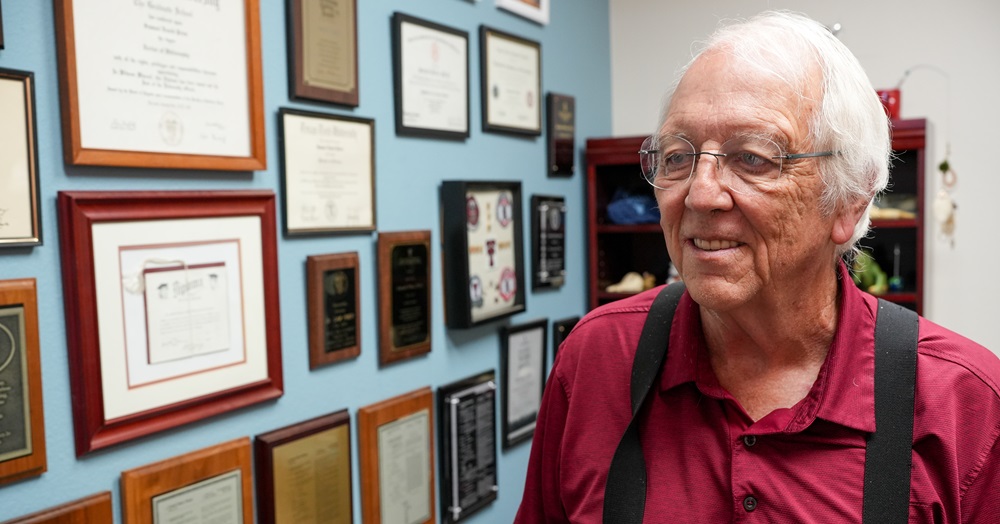
On the third floor of the Texas Tech University Health Sciences Center (TTUHSC), there is an office that will soon be empty. After nearly 50 years with the university, Samuel Prien, Ph.D., has been packing up his office in preparation for retirement in August. Although he’s moving on, his impact will remain.
Prien has a unique role within the Texas Tech University System. He is dual-appointed as a professor in the TTUHSC School of Medicine Department of Obstetrics and Gynecology and in the Texas Tech University (TTU) Department of Animal and Food Sciences.
“I teach med students,” Prien said. “I teach residents. I teach undergraduates. I teach graduates. So, I teach everybody. I estimate roughly 10,000 people have been impacted by what I’ve done.”
Visitors to Prien’s office are first greeted by a wall of his accomplishments. The collage of diplomas, awards, fellowships and patents is a small, visual representation of Prien’s many achievements. However, he quickly points visitors to the opposite wall.
“The side over here means a lot more to me,” Prien said. “Those are things from my students.”
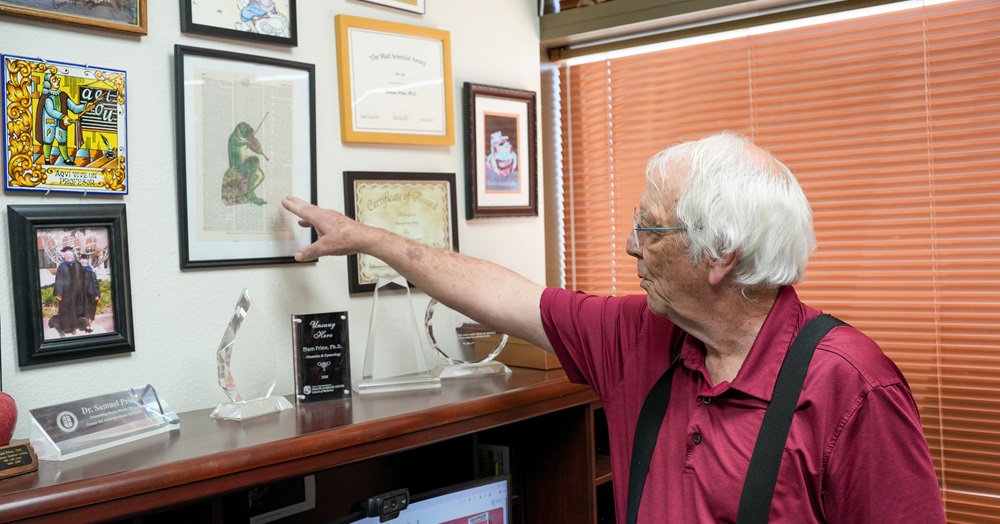
Above his desk, Prien has a collection of drawings, paintings and photos.
“It’s amazing the talents the people who’ve been in my lab have,” Prien said. “I don’t look at them as the things they are. Every time I look at them, I see the person that was there.”
Prien beams when he talks about teaching, but he downplays his influence.
“I had people that took chances on me,” he said. “My small bit of paying them back is to take others that I recognize those same talents in and let them be what they can be.”
Sanjana Akula, a graduate student in the TTU Department of Animal and Food Sciences, will be one of Prien’s final students.
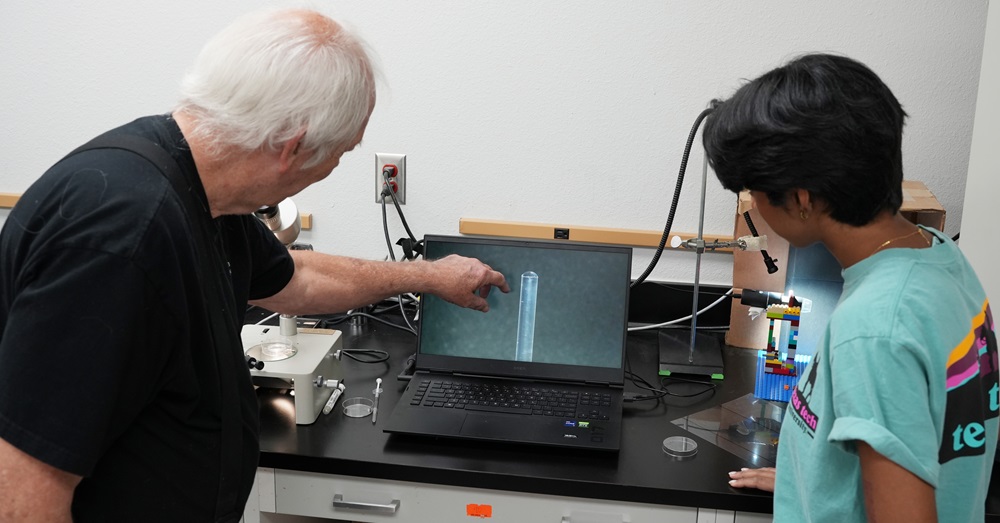
“I feel like everyone that I have been taught by, for reproductive physiology specifically, has either been Dr. Prien or been taught by Dr. Prien,” Akula said.
“Think of all this as being like a ripple in the pond,” Prien said. “I’m the stone. The ripples are spreading. Hopefully, they spread forever. They [the students] make their own ripples, and everything gets better.”
Prien’s ripples spread far beyond the halls of TTUHSC. His innovations in fertility treatments have helped thousands of people build families.
“In the time I’ve been here, I estimated at least 3,800 babies,” Prien said. “That’s probably an underestimate. I know we averaged for a while 100 babies a year.”
Prien was part of the first successful birth through Assisted Reproductive Technology (ART) at TTUHSC in the late 1980s.
“The first, that was called the GIFT [gamete intra-fallopian transfer] baby at the time, because we were still learning how to culture embryos,” Prien said. “What we would do is take her eggs, his sperm, we would put them back into her fallopian tube and let fertilization take place normally. That was the first successful, what we now refer to as the reproductive technologies, not just in vitro fertilization (IVF). Then about three months later, we had our first IVF success. And from there, a lot of babies have been born.”
Prien’s work led him to question the processes used in semen sample collection.
“We collect it in a cold, hard specimen cup and then we worry about taking care of it,” Prien said. “Why don’t we take care of it at collection?”
That idea led Prien and Dustie Johnson, Ph.D., a graduate student in the TTU Department of Animal and Food Sciences at the time, to develop a collection cup that allowed semen to survive longer. The team received a patent for the device in 2005.
“We’ve been able to show through a lot of publications and now a lot of other people using it, that if you treat it better at the beginning, there’s a better chance it’s going to be able to do its job back at the end,” Prien said.
Innovation did not stop there. Prien and Lindsay Penrose, Ph.D., an associate professor of Obstetrics and Gynecology at the TTUHSC School of Medicine, developed an improved version of the cup and received a patent for the device in 2022. It’s now being sold under the brand name ProteX. In a clinic, the cup can be used with a barrier system, also developed by Prien and Penrose, that isolates healthier sperm. The device, called the NovoSort barrier, can eliminate the need for techniques such as centrifugation, which sometimes causes DNA damage.
“Other people besides us have shown not only an increase in pregnancy rates, but also more [families] take home babies,” Prien said. “And in my world, that’s what we’re shooting for.”
Prien and Penrose also invented a new method to select viable embryos for ART based on buoyancy. The now patented system uses non-invasive techniques, lowering risks to viable embryos.
“It’s the coolest thing to be a part of this,” Akula said.
She is now utilizing the buoyancy method with Prien.
“Not a lot of people get to have this experience, and it’s really unique,” Akula said. “I’m so grateful to be a part of it, especially on the tail end. I get to work off what so many other students have learned from Dr. Prien and so much of the knowledge that they’ve built themselves. I feel like I was given a platter.”
Prien says the buoyancy idea came from his connection to livestock research at TTU.
“I was actually at a conference about cattle,” Prien said.
The presentation on Jersey cattle, which produce milk with a high fat content, led Prien to think about a connection to the heifer’s egg.
“I thought, well if she’s fatty, maybe the egg is fatty too,” Prien said. “Nobody could tell me the answer.”
Research to see if his hypothesis was correct led Prien to connect with processes used by meat scientists.
“When they’re trying to determine how much fat is in a carcass, they sometimes float it in a bath,” Prien said.
Prien and Penrose used that idea to invent the buoyancy method and received the patent in 2021.
“We have been the first to estimate the weight of that actual egg cell, then embryo,” Prien said. “We’ve been able to determine if it’s in that normal weight range, there’s a good chance it’s going to make a cow.”
It’s an advancement that has the potential to benefit not only cattle production, but also families.
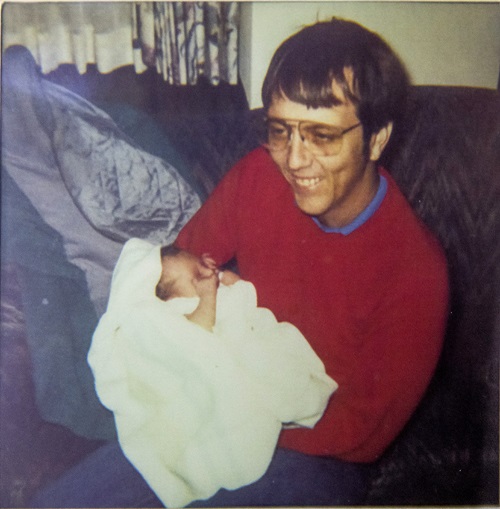
“People say ‘You’re going to get rich,’” Prien added. “Rich doesn’t matter. It’s about maybe those people took home a baby they would not have taken home had they not used what we were able to come up with.”
He emphasized the “we” in his work includes students.
“They’ve all done a lot of heavy lifting for what this crazy old professor had come up with in his brain,” Prien said.
His innovations led to many awards. The National Academy of Inventors (NAI) named Prien to the inaugural class of Senior Members in 2019. He became the first TTUHSC faculty member to be named an NAI Fellow in 2022.
As he prepares to close this chapter of his career, Prien says he’s “worked” very few days in his life.
“I’ve had the opportunity to do what I love for a very long period of time,” Prien said. “My undergraduate and my graduate degrees are all from Texas Tech University. I started off in plants, and now I do human embryos.”
Prien continued, “I’ve seen this place grow and with it I hope I’ve grown. I’ve been blessed with being able to train 50 students or more. I’ve been able to do research that I hope has had an impact and create all these things.”
For his next chapter, Prien said he will continue to work, but on what is still being written.
“I’ve already had a number of people approach me about all kinds of crazy things, and who knows what I’ll get involved in next?”
Related Stories
TTUHSC Researchers Collaborate in Study of Cancer Drug’s Possible Positive Effects on Alzheimer’s Disease
A drug typically used to treat some forms of cancer may also help delay the progression of Alzheimer’s disease. Boris Decourt, Ph.D., director of the TTUHSC Laboratory on Neurodegeneration and Translational Research, is part of the Phase II trial.
TTUHSC Professor Reflects on Decades of Research Benefitting Thousands of Families
After nearly 50 years with the university, Samuel Prien, Ph.D., has been packing up his office in preparation for retirement in August. Although he’s moving on, his impact at TTUHSC will remain.
Student Research Shows Positive Outcomes from Summer Research Program
Medical student involvement in research is growing, encouraging medical schools to develop programs that support student research plus faculty time for research and mentorship. The Medical Student Summer Research Program (MSSRP) at TTUHSC provides these opportunities, and new research shows positive outcomes.
Recent Stories
TTUHSC Researchers Collaborate in Study of Cancer Drug’s Possible Positive Effects on Alzheimer’s Disease
A drug typically used to treat some forms of cancer may also help delay the progression of Alzheimer’s disease. Boris Decourt, Ph.D., director of the TTUHSC Laboratory on Neurodegeneration and Translational Research, is part of the Phase II trial.
TTU System Board of Regents Approves Appointment of Grover E. Murray Professor
The Texas Tech University System Board of Regents today (Aug. 13) approved the appointment of Rodney Young, M.D., from the Texas Tech University Health Sciences Center (TTUHSC) School of Medicine, as a Grover E. Murray Professor.
From Backpacks to White Coats
TTUHSC School of Medicine Admissions Office team members delivered critical school supplies worth nearly $6,500 in total on Thursday, Aug. 6, to Bayless Elementary School.