
Tai Chi Chuan: A Martial Art With Health Benefits for all Ages
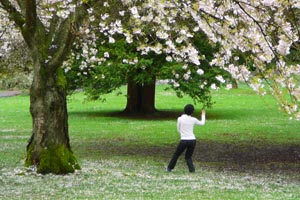
Numerous forms of Tai Chi are practiced around the world.
This month's Integrative Medicine Lecture Series at noon Sept. 3 in Room 2B152, will feature "Tai Chi Chuan a martial art with health benefits for all ages," presented by Jane Colmer-Hamood, Ph.D., associate professor in the Department of Immunology and Molecular Microbiology.
Lunch will be served at 11:50 a.m. to the first 40 attendees.
The free event is hosted by the Division Integrative Medicine and co-organized by Integrative and Complementary and Alternative Medicine (ICAM) student club. The presentation is part of an ongoing lecture series on issues related to integrative medicine and complementary and alternative medicine.
The practice of Tai Chi Chuan began in China in between 300 and 700 years ago, depending on whose theory you prefer, as a martial art for defense training.
Today, numerous forms of Tai Chi are practiced around the world, all built on five different styles that vary in the speed at which the movements are made, the number of movements made and how large or small the postures are within the movements.
Colmer-Hamood will present the three aspects of the study of Tai Chi Chuan health, meditation and martial art although the presentation will focus on health aspects. Summaries of current research examining the health benefits also will be covered, as well as a brief demonstration of Tai Chi Chuan forms and an opportunity for participants to try the movements themselves.
Colmer-Hamood began studying the Tai Chi Yang style “long form” in 2009 and has continued retaining her ability to practice the Yang style 24-form “short form” for six years. For five years, she has led a free class at TTUHSC that has included faculty, staff, students and community members.
She completed her Ph.D. in medical microbiology from the Graduate School of Biomedical Sciences in 1997. Colmer-Hamood received the Dean’s Basic Science Teaching Award for 2006, 2009 and 2011 and the Outstanding Teacher of the Year for MS II in 2012 and 2014.
For more information about the Integrative Medicine Lecture Series, contact Yan Zhang, Ph.D., L.Ac., director, Division of Integrative Medicine, at yan.zhang@ttuhsc.edu or Asha Kovelamudi, ICAM president, at asha.lovelamudi@ttuhsc.edu.
Related Stories
38th Student Research Week Successful at Showcasing Secrets of Immune Defense
Student researchers at TTUHSC had the opportunity to showcase their presentation skills at the 38th Annual Student Research Week Feb. 25 – 27.
Celebrating Veterans: TTUHSC’s General Martin Clay’s Legacy of Service and Leadership
From his initial enlistment in the Army National Guard 36 years ago to his leadership in military and civilian health care management roles, Major General Martin Clay’s career has been shaped by adaptability, mission focus and service to others.
Texas Tech University Health Sciences Center School of Nursing Named Best Accelerated Bachelor of Science in Nursing Program in Texas
The TTUHSC School of Nursing Accelerated Bachelor of Science in Nursing (BSN) program has been ranked the No. 1 accelerated nursing program in Texas by RegisteredNursing.org.
Recent Stories
Texas Tech University Health Sciences Center Announces Relocation and Expansion of the TTUHSC School of Nursing Mansfield Instructional Site
TTUHSC and the City of Mansfield announced a new collaboration to relocate and expand the School of Nursing’s existing Mansfield instructional site during the Mansfield City Council meeting on Monday, Aug. 24.
TTUHSC Recognized for Commitment to Improving Experiences and Advancing Outcomes for First-Generation College Students
FirstGen Forward announced TTUHSC is a new member of the FirstGen Forward Network Class of 2026. FirstGen Forward selected TTUHSC because the university demonstrated a commitment to improving experiences and advancing success for first-generation college students.
TTUHSC Researchers Collaborate in Study of Cancer Drug’s Possible Positive Effects on Alzheimer’s Disease
A drug typically used to treat some forms of cancer may also help delay the progression of Alzheimer’s disease. Boris Decourt, Ph.D., director of the TTUHSC Laboratory on Neurodegeneration and Translational Research, is part of the Phase II trial.