
Clinical Research Institute a Source of Pride for Retiring Griswold
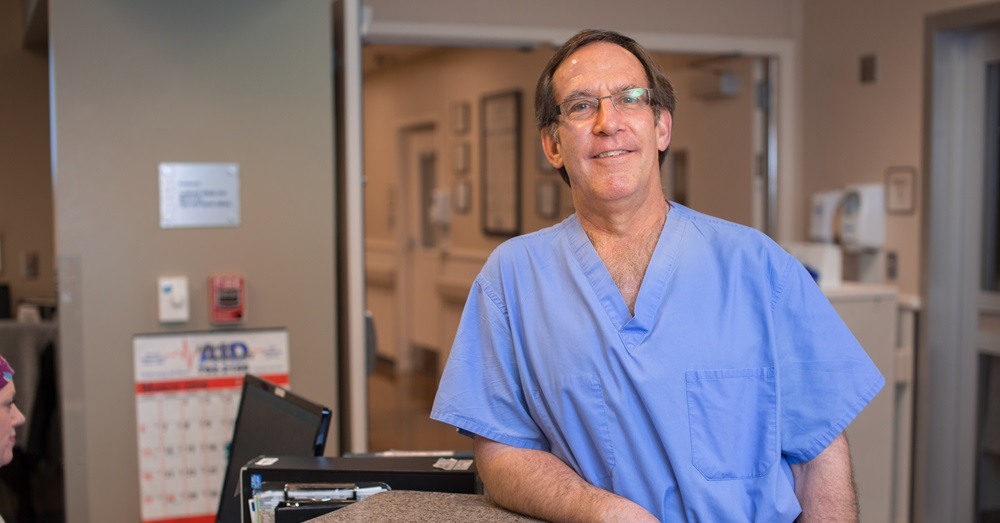
When he interviewed to become the Department of Surgery chair for the Texas Tech University Health Sciences Center (TTUHSC) in the late 1990s, John Griswold, M.D., told School of Medicine leadership conducting the search that his vision was to establish a full-service surgery department. He compared his proposal to creating a four-legged department stool supported by financial stability, quality patient care, trainee education and, most importantly in his mind, research.
“From the research perspective, when I looked at the lay of the land, I was to be one of about six faculty,” Griswold recalled. “All of them were very high-quality general surgeons who loved to teach, and they were doing great patient care. But not a single one of them had done research. In fact, none of them had an interest in doing research, and there was no money to do research. It was just a perfect environment for failure. So I wanted to get research active, which also would help us financially.”
Griswold said submitting grant applications presented an opportunity to boost research activities and funding, but he opted to fuel TTUHSC’s research engine by partnering with industry and getting started in clinical trials which were primarily focused on pharmaceutical drugs.
“Since my interest is in burns, trauma and critical care, we used the ICU environment to work with the big pharmaceutical companies on medications they were investigating and studying in humans to get approval through the FDA,” Griswold said. “There were two nurses working in the ICU at the time: Cathy Lovett was one of them, and Stacy Pugh, who's since left TTUHSC and moved up the corporate ladder of a number of pharmaceutical and device companies, was the other. I got very lucky, because they both were a natural fit for clinical research.”
Working together, Griswold, Lovett and Pugh began conducting clinical trials for what was then known as the Clinical Research Division within the Department of Surgery. Griswold said they became quite successful on the financial side and, more importantly, in creating an environment where everybody in the department became accustomed to hearing about and participating in clinical research. Some faculty clinicians had patients participating in trials the department was conducting, and it became a group effort led by the research exposure and opportunities provided by Griswold.
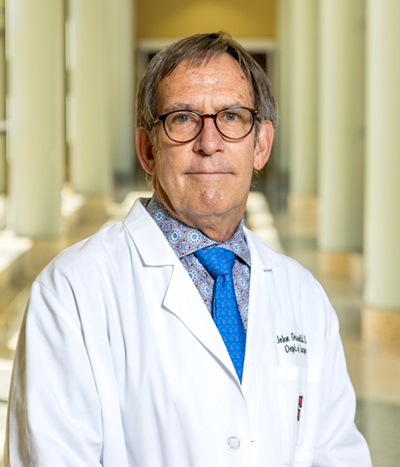
“Dr. Berk saw what we were doing, and he wanted to make it all a School of Medicine thing,” Griswold said. “He wanted to make it into an opportunity that all faculty and trainees in the School of Medicine could take advantage of, not just the surgery and internal medicine departments.”
Griswold said Berk also wanted to increase research to help faculty gain promotions and tenure, which many were struggling to accomplish. At that time, the percentage of tenured faculty was very low, and promotions to associate professor or full professor were rare and well below the percentages nationally and at other Texas institutions.
With Berk as dean, the clinical research department continued to evolve, and all employees moved into the School of Medicine dean's office. Barbara Pence, Ph.D., was named director, a welcome step to Griswold, whose responsibilities with the trauma center, the burn center and the Department of Surgery were making his oversight of the clinical research division a difficult task.
Though Griswold still was involved on the periphery, the division continued as it was for about the next six years, and promotion and tenure were improving exactly as Berk had envisioned. As the number of faculty and trainees taking advantage of the Clinical Research Division opportunities continued to grow, Berk began discussions in 2015-2016 with TTUHSC President Tedd L. Mitchell, M.D., about designating the School of Medicine’s Clinical Research Division a TTUHSC institute, which would make its resources available to all university faculty and trainees, regardless of school or program.
That marked the official beginning of the Clinical Research Institute — the CRI — at TTUHSC. For several years, the CRI was managed by Lovett, Lorenz “Laurie” Lutherer, M.D., Ph.D., and others until 2018, when Berk asked Griswold to become its executive director.
“We had a lot of conversations because I was already really busy, but he thought I could do it,” Griswold said. “I wasn't so sure. But I'd already stepped down as surgery department chair, so that helped. Finally, in September 2019, I agreed and officially became the executive director, and I have been in that position since.”
As executive director, Griswold eventually brought in Jenna Kesey, Ph.D., the first nurse practitioner he had worked with in the burn center during the early 2000s. As she worked with Griswold, Kesey also earned several other degrees related to computer science and electronic medical records. She left the burn center for about two years, working as a data scientist for UMC and earning her Ph.D. in nursing.
When Lovett decided to retire, she and Griswold begin searching for her replacement. After the candidate interview process was completed, Lovett and Griswold believed Kesey would be a perfect fit for the CRI job. She agreed to take the position in November 2024, and after some training and tutoring for the position, Kesey became the CRI’s current managing director in January 2025.
As his end-of-November retirement date approaches, Griswold said there are several things he’s proud of when it comes to the CRI, starting with the institute’s three working areas: regulatory, coordinators and biostatisticians.
The CRI’s regulatory area is where all the Institutional Review Board (IRB) work is conducted. Griswold said the group is incredibly knowledgeable about formatting research projects into an IRB process.
“If you use the CRI for nothing else, you have to use it for IRB work,” Griswold said. “We're very fortunate to have some very smart people that are working in the middle of that regulatory arena, but the regulatory group also does repetitive internal auditing on almost every study, be it a small, retrospective study (a study that analyzes existing data from the past) or a large clinical trial or clinical research project. They do internal monitoring, just like monitoring goes on in the industry environment, so that it helps everybody stay on their toes and make sure that they're doing everything right, whether it's patient protection through HIPAA (the Health Insurance Portability and Accountability Act of 1996), extracting electronic medical records or following all of the federal regulations as far as research. The regulatory group has a lot of administrative expertise, and I think people don't really recognize how that group really keeps everybody moving in the right direction.”
The coordinators, Griswold said, are experts at managing prospective trials where patients are followed over a period of time to track their outcomes, and they also excel at getting patients’ consent appropriately and following the appropriate reporting format. He credits Lovett and Kesey for the training that prepares CRI coordinators to be so efficient at their jobs.
“The scary part is they have created such a good orientation for these new coordinators that it’s possible for them to go any place in the country and be a coordinator and do top-notch work because they're so well trained,” Griswold added.
When it comes to biostatistics, Griswold said there have been some struggles along the way, but he is proud to say that isn’t the case today.
“The biostatisticians help the coordinators and the regulatory people morph the project into a well-structured, scientific question that can be researched, and then they do all the statistical analysis for everybody,” Griswold said. “The turnaround is about two days, which is amazing to me. Those three entities — regulatory, coordinators and biostatisticians — I'm very proud of them all.”
Another source of pride for Griswold is the CRI’s support for students. Just before the pandemic, in 2019-2020, there were some grading changes in the School of Medicine, and some of the important assessment tests became pass-fail. That took away an objective process for residency programs to assess people side-by-side. Now, Griswold said, research has become one of the ways a medical student can set themselves apart from their peers when looking at residencies, and the CRI has stepped up and taken on much of that responsibility.
“I write a lot of letters of recommendation for students going into residency in all different disciplines, and when they show me their CV, it is far stronger than many of the CVs I saw for people looking for a faculty position when I was a chair,” Griswold said. “I mean, it's just amazing. Now, probably a lot of them won't go on to spend much, if any time, generating research data once they get into practice, but it's amazing to see how the CRI has helped. The students will tell you that for the last three or four years, it's the research and the CRI that helped them get their top choice or one of their higher choices of residency. I think it's because the CRI itself is very impressive, and its support of the trainees is what I'm most proud of.”
As he prepares to retire from TTUHSC, it’s going to be a happy-sad situation for Griswold. He believes he did everything he could to develop a level one trauma center, which is why he initially came to TTUHSC. He also put much effort into what is now the UMC Timothy J. Harnar Burn Center and created a program that continues to grow and flourish. Griswold’s vision and leadership also were crucial in strengthening the Department of Surgery. Each of those areas has been easy to pass on to other people because he left them in good shape.
The CRI, however, is one entity Griswold has a small amount of guilt about leaving. His hope is that the CRI will continue to flourish because he believes continued support of clinical research is vital and beneficial to the university, both in scholarship and financially.
“Clinical research is still fledgling,” Griswold surmised. “We're not broken at all in educating students in any field, because all of our students outshine all other students when they go to the next level. But obviously, there are always administrative and outside pressures that change or impact the focus of leadership, but my hope is that our leaders will realize that clinical research is probably their number one area of importance to spend energy and put support into. If they do that, then I think all the other issues they're also trying to deal with become much easier to address because of the strength that clinical research brings to an institution such as TTUHSC.”
Related Stories
TTUHSC Professor Reflects on Decades of Research Benefitting Thousands of Families
After nearly 50 years with the university, Samuel Prien, Ph.D., has been packing up his office in preparation for retirement in August. Although he’s moving on, his impact at TTUHSC will remain.
Student Research Shows Positive Outcomes from Summer Research Program
Medical student involvement in research is growing, encouraging medical schools to develop programs that support student research plus faculty time for research and mentorship. The Medical Student Summer Research Program (MSSRP) at TTUHSC provides these opportunities, and new research shows positive outcomes.
‘Tropical Neglected Disease’ Not Forgotten by TTUHSC Researcher
Afzal Siddiqui, Ph.D., director of the TTUHSC Center for Tropical Medicine and Infectious Diseases, developed SchistoShield®, a vaccine to treat schistosomiasis, as a humanitarian effort, rather than making it for profit.
Recent Stories
From Backpacks to White Coats
TTUHSC School of Medicine Admissions Office team members delivered critical school supplies worth nearly $6,500 in total on Thursday, Aug. 6, to Bayless Elementary School.
TTUHSC School of Medicine Students Receive First White Coat
The TTUHSC School of Medicine Class of 2030 received their first white coat and pledged their commitment to the medical profession at the White Coat Ceremony today.
TTUHSC Professor Reflects on Decades of Research Benefitting Thousands of Families
After nearly 50 years with the university, Samuel Prien, Ph.D., has been packing up his office in preparation for retirement in August. Although he’s moving on, his impact at TTUHSC will remain.