
New Partnership to Help Children Read and Learn
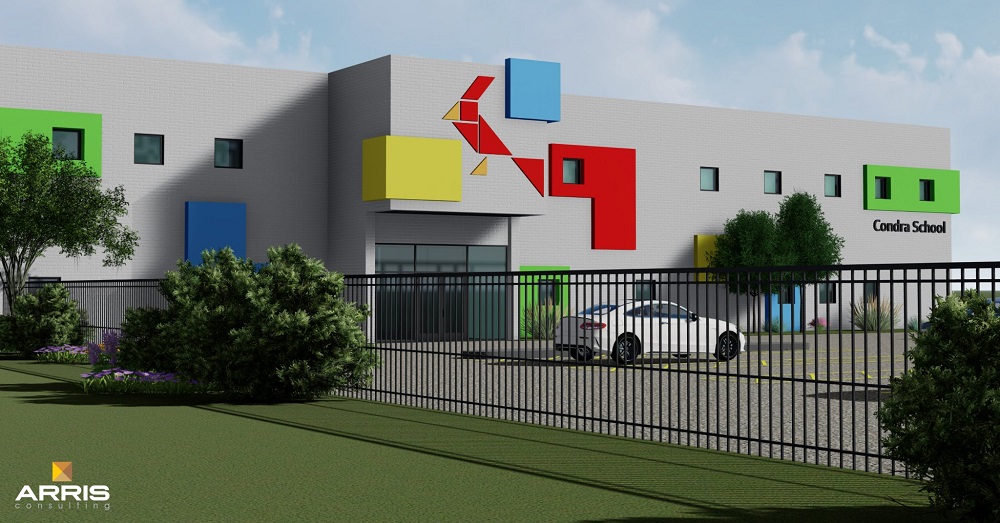
The Betty M. Condra School for Education Innovation
The Betty M. Condra School for Education Innovation announced an exciting new partnership with Texas Tech University Health Sciences Center (TTUHSC) Department of Speech, Language and Hearing Sciences this February, during a ribbon cutting ceremony to unveil its new home in downtown Lubbock. Two TTUHSC researchers, Tori Gustafson, Au.D, CCC-A, and Tobias Kroll, Ph.D, CCC-SLP, will conduct research in order to improve education for students with unique learning needs.
The partnership began when a friend of Gustafson, who works for the Condra school, asked for assistance with hearing screenings.
“While performing screenings, the school administration was asking about kids who seem to have difficulty understanding what they hear but do not have a hearing loss,” explained Gustafson. “We discussed how some children have an auditory processing difficulty, including the possible relationship between APD and reading difficulties.”
The public charter school is free for students and provides education to children with learning differences by helping with instruction, modification and accommodations to boost academic performance and prepare students for a successful transition into public schools. As a charter school with a population of children with reading difficulties, research is part of Condra’s charter. The school became interested in examining why some children may do well in reading programs, while others do not.
“I contacted Dr. Kroll because of his research in reading,” said Gustafson. From there, a collaboration began that could benefit the lives of many young people.
The Study and its Goals
The current study by Kroll and Gustafson will examine relationships of different language, reading and auditory processing skills to help determine unique factors seen in these children that contribute to success, or lack thereof, in improving reading. The long-term goal of this collaboration is to develop intervention to help children who are not responding well to traditional therapy.
“We will be testing children at the Condra school for auditory processing disorder and language skills to see if there is a pattern for the children who do not show success in a reading remediation program,” said Gustafson.
“The idea behind it is to reach kids who are struggling with reading and for whom business-as-usual intervention doesn’t work,” said Kroll, who explained that according to some research, that may be 15% to 80% of all children who receive evidence-based, effective intervention.
“Reading is a very individual process where readers bring a whole array of cognitive-linguistic-auditory skills to the task,” Kroll said. Success depends on each of these skills, and the coordination of these skills while reading.
According to Kroll, “business-as-usual” reading interventions don’t work for a sizeable population of kids for a couple of different reasons, the first of which is that they are not individualized.
“They are one-size-fits-all—that is, they target one or a few sub-skills regardless of what the kid needs,” Kroll said.
The second reason is that the standard interventions do not fully consider the extent to which reading may be an auditory process. Kroll pointed out that written language is first translated into sounds before it makes sense in a person’s brain—therefore, reading can be affected by auditory processing issues.
A Mutually Beneficial Partnership
These studies are not just to obtain research for TTUHSC, but to help the current and future students at the school who might be struggling.
“Once test results are obtained and any possible patterns are identified, the plan is to see if Dr. Kroll can work with the TTUHSC Speech, Language and Hearing Clinic to provide intervention that is tailored to meet the needs of the children that are not responding to traditional therapy,” said Gustafson. “This will help the Condra school be able to work toward being able to provide programs for children that are struggling to read and not responding to current programs.”
Kroll and Gustafson are excited to pursue this opportunity, and Kroll credits Gustafson for bringing this area of research to his attention.
“Dr. Gustafson has made this possible thanks to her community connections,” said Kroll. “She put an aspect of reading on my radar that no one in the literacy world talks about: auditory processing. I’m excited to pursue this line of work with her.”
More information about the school and enrollment is available at the Condra charter school’s website.
Related Stories
TTUHSC Researchers Collaborate in Study of Cancer Drug’s Possible Positive Effects on Alzheimer’s Disease
A drug typically used to treat some forms of cancer may also help delay the progression of Alzheimer’s disease. Boris Decourt, Ph.D., director of the TTUHSC Laboratory on Neurodegeneration and Translational Research, is part of the Phase II trial.
TTUHSC Professor Reflects on Decades of Research Benefitting Thousands of Families
After nearly 50 years with the university, Samuel Prien, Ph.D., has been packing up his office in preparation for retirement in August. Although he’s moving on, his impact at TTUHSC will remain.
Student Research Shows Positive Outcomes from Summer Research Program
Medical student involvement in research is growing, encouraging medical schools to develop programs that support student research plus faculty time for research and mentorship. The Medical Student Summer Research Program (MSSRP) at TTUHSC provides these opportunities, and new research shows positive outcomes.
Recent Stories
TTUHSC Researchers Collaborate in Study of Cancer Drug’s Possible Positive Effects on Alzheimer’s Disease
A drug typically used to treat some forms of cancer may also help delay the progression of Alzheimer’s disease. Boris Decourt, Ph.D., director of the TTUHSC Laboratory on Neurodegeneration and Translational Research, is part of the Phase II trial.
TTU System Board of Regents Approves Appointment of Grover E. Murray Professor
The Texas Tech University System Board of Regents today (Aug. 13) approved the appointment of Rodney Young, M.D., from the Texas Tech University Health Sciences Center (TTUHSC) School of Medicine, as a Grover E. Murray Professor.
From Backpacks to White Coats
TTUHSC School of Medicine Admissions Office team members delivered critical school supplies worth nearly $6,500 in total on Thursday, Aug. 6, to Bayless Elementary School.