
Internship Takes Students Beyond the Books
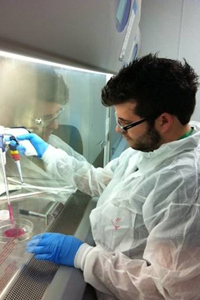
Students like Johnathan Salim Abou-Fadel in the SABR program were given the opportunity to conduct hands-on research before entering graduate school.
The El Paso campus recently opened its first Summer Accelerated Biomedical Research (SABR) internship program for students interested in gaining research experience before entering graduate school.
“In its inaugural year, the SABR program was a tremendous success,” said Charles Miller, Ph.D., associate dean for research with the Graduate School of Biomedical Sciences. “All of the students had engaging projects and their presentations at the capstone symposium in Lubbock were very well received.”
The 10-week opportunity was open to undergraduate students majoring in biology, chemistry and engineering; students between junior and senior years; and current graduates without graduate course work.
Six University of Texas at El Paso undergraduate students were recruited and paired with a TTUHSC El Paso researcher. Students were given a $3,800 stipend to work on a research project that was then presented to fellow SABR interns at the final research symposium in Lubbock.
SABR participant and Johnathan Salim Abou-Fadel researcher Huanyu Dou, Ph.D., and took on cancer with his research project titled, “Therapeutic Efficacy of Nano-Formulated Paclitaxel on Glioblastomas”.
“The techniques that I learned were above and beyond anything I could have learned in a two-month period," said Salim Abou-Fadel. "This internship gave me the feel of what it is like to work in the lab under very strict aseptic conditions while working under a very strict time-frame. I learned techniques that I will carry with me for the rest of my life.”
Other SABR students included Gabriel Espinoza, Spoorthi Lawson, Cynthia Gabaldon, Oliver Servin and Sylvia Mejia.
SABR originated at the Graduate School of Biomedical Sciences in Lubbock. The school has faculty involved in research using state-of-the art labs and equipment.
Related
El Paso Takes ACCION Against Colorectal Cancer
Researchers Debunk Classic Myths of Condition Often Seen in Critical Care Patients
Related Stories
38th Student Research Week Successful at Showcasing Secrets of Immune Defense
Student researchers at TTUHSC had the opportunity to showcase their presentation skills at the 38th Annual Student Research Week Feb. 25 – 27.
Celebrating Veterans: TTUHSC’s General Martin Clay’s Legacy of Service and Leadership
From his initial enlistment in the Army National Guard 36 years ago to his leadership in military and civilian health care management roles, Major General Martin Clay’s career has been shaped by adaptability, mission focus and service to others.
Texas Tech University Health Sciences Center School of Nursing Named Best Accelerated Bachelor of Science in Nursing Program in Texas
The TTUHSC School of Nursing Accelerated Bachelor of Science in Nursing (BSN) program has been ranked the No. 1 accelerated nursing program in Texas by RegisteredNursing.org.
Recent Stories
Texas Tech University Health Sciences Center Announces Relocation and Expansion of the TTUHSC School of Nursing Mansfield Instructional Site
TTUHSC and the City of Mansfield announced a new collaboration to relocate and expand the School of Nursing’s existing Mansfield instructional site during the Mansfield City Council meeting on Monday, Aug. 24.
TTUHSC Recognized for Commitment to Improving Experiences and Advancing Outcomes for First-Generation College Students
FirstGen Forward announced TTUHSC is a new member of the FirstGen Forward Network Class of 2026. FirstGen Forward selected TTUHSC because the university demonstrated a commitment to improving experiences and advancing success for first-generation college students.
TTUHSC Researchers Collaborate in Study of Cancer Drug’s Possible Positive Effects on Alzheimer’s Disease
A drug typically used to treat some forms of cancer may also help delay the progression of Alzheimer’s disease. Boris Decourt, Ph.D., director of the TTUHSC Laboratory on Neurodegeneration and Translational Research, is part of the Phase II trial.